For many new shoppers, the hardest part of purchasing liquidation items isn't finding things but actually knowing what you’re searching for.
Liquidation listings may have 100s of different products, numerous condition grades, estimated retail pricing, and spreadsheets with tons of technical specifications. For seasoned purchasers, there are lots of factors here to help assess each opportunity and determine risk. However, novices and inexperienced buyers may find these confusing, and difficult to comprehend.
This is why liquidation manifests are critical to the buyer's experience.
A manifest isn't just one of the spreadsheets that go with pallet listing. It is one of the most significant tools for buyers to have in order to assess the quality of the inventory being purchased, the potential resale value of each item, and the transparency of the source prior to committing to buy something.
Understanding how to effectively utilize a liquidation manifest can help buyers:
- Create more knowledgeable buying decisions
- Find cleaner and better organized inventory
- Avoid making inaccurate assumptions about retail value
- Have more realistic expectations of product quality
- Create a better resale strategy at the outset of the sale.
In this guide, you’ll learn how liquidation manifests work, the various sections of the manifest, and how buyers can utilize manifests to decrease their risk and source items with greater assurance.
What Is a Liquidation Manifest?
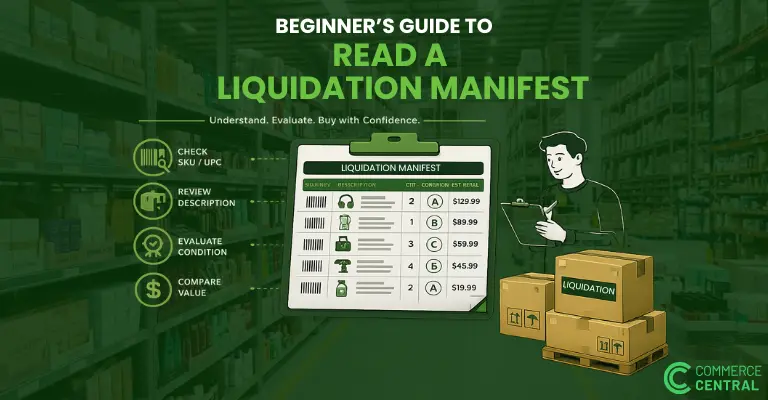
A liquidation manifest is the list of the items in a pallet, truckload, or liquidation lot and is used to provide information about what has been purchased from the supplier.
A typical liquidation manifest will include:
- A list of all items on the pallet or in the truckload including their names and descriptions
- The manufacturer's name or brand
- SKU or UPC codes
- The number of each item in the load
- The condition of the merchandise
- The estimated retail value
- The item categories of the items in the load
- Any notes about how the merchandise is packaged or how complete it is
Consequently, you could look at the manifest as the "inventory map" of the load. The manifest also allows buyers to see what they will be getting before receiving the inventory.
In the liquidation business, there can be a considerable amount of variability with the products and the condition of the inventory, so the manifest minimizes uncertainty.
The quality of the manifest often reflects the quality of the sourcing process used to obtain the inventory.
Why Liquidation Manifests Matter So Much
Liquidation Inventory- For most traditional wholesale buyers, typically they will have a very clear understanding of the items they are purchasing. Liquidation is different than traditional wholesale buying since the inventory can consist of:
- Customer returns
- Overstock products
- Shelf pulls
- Open box merchandise
- Mixed condition items
Therefore, without any reliable documentation, liquidation buyers will have no idea regarding what they are purchasing.
The use of a structured manifest gives the liquidation buyer the ability to:
- Research products prior to purchasing them
- Be more accurate regarding resale potential
- Identify inventory risks upfront
- Be able to develop pricing and listing strategies
For first-time buyers, this information can be very valuable in identifying organized inventory items from bulk loads of inventory that may lead to operational issues in the future.
The greater amount of transparency relative to the manifest, the more informed the buyer's sourcing decisions will be.
Understanding the Most Important Sections of a Manifest
Product and Description
The product title section identifies what inventory is included in the load.
Detailed manifests usually provide:
- Exact product names
- Model numbers
- Brand names
- Product variations or specifications
This level of detail is important because it allows buyers to:
- Research resale demand
- Compare prices across marketplaces
- Identify restricted or gated products
- Understand category relevance
For example, a manifest that simply says “assorted home goods” offers very little insight. On the other hand, a manifest listing exact products, brands, and model information allows buyers to evaluate inventory more accurately.
Clear product descriptions also indicate that inventory has been processed and documented carefully.
SKU and UPC Information
To identify inventory by product level buyers can use SKU (stock keeping unit) and UPC (universal product code) identifiers. The SKU and UPC identifiers are important because they allow buyers to:
- Match products to marketplace listings.
- Look up previous selling prices.
- Analyze the level of competition.
- Verify if the product is authentic.
- Understand any restrictions on categories of products.
Buyers who have experience will frequently be able to utilize sku/upc numbers for research of products that already have strong demand on marketplaces such as Amazon or eBay.
A beginner may find that learning how to utilize SKU/UPC identifiers can help them develop confidence in their purchasing decisions.
Inventories with no identifiers create an additional level of research complexity and make assessing inventory levels less accurate.
Quantity Breakdown
Quantity information shows how many units of each product are included in the load.
At first glance, this may seem straightforward, but quantity distribution has a major impact on resale strategy.
For example:
- Large quantities of the same item may increase competition
- Smaller quantities may sell faster due to lower saturation
- Repeated SKUs may require pricing adjustments to move inventory efficiently
Understanding quantity breakdowns also helps buyers estimate:
- Listing workload
- Storage requirements
- Sell-through timelines
Organized manifests typically present quantities clearly and consistently, making inventory planning much easier.
Product Condition Grading
Condition grading is one of the most important and often misunderstood parts of a liquidation manifest.
Most manifests use grading categories such as:
- New
- Like New
- Open Box
- Customer Returns
- Salvage
These labels directly affect:
- Resale value
- Customer expectations
- Marketplace eligibility
- Return risk
For example, “Open Box” inventory may still be fully functional but could have damaged packaging or signs of handling. “Customer Returns” may vary significantly depending on inspection standards.
This is why experienced buyers rarely evaluate manifests based only on retail value. Condition grading plays a major role in determining what inventory is realistically worth in resale markets.
Reliable manifests provide clear grading definitions rather than vague descriptions like “mixed condition.”
Estimated Retail Value
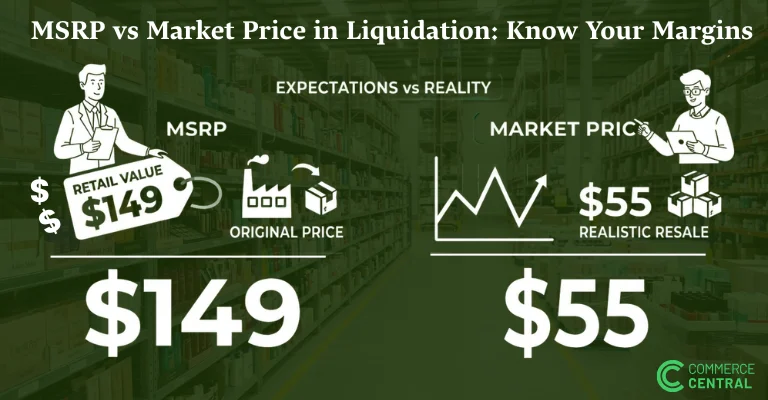
Most liquidation manifests include estimated retail value, often based on MSRP.
While this number can provide useful context, it should not be treated as guaranteed resale value.
Retail estimates do not account for:
- Product condition
- Marketplace competition
- Demand fluctuations
- Pricing pressure in secondary markets
A strong manifest helps buyers move beyond retail totals and focus on realistic resale potential instead.
Experienced buyers use retail value as a reference point not as the primary reason to purchase inventory.
How First-Time Buyers Should Analyze a Manifest
Focus on Inventory Consistency
One of the first things buyers should evaluate is whether the inventory appears organized and intentional.
Clean, structured manifests usually include:
- Related product categories
- Logical grouping of SKUs
- Consistent grading standards
Disorganized manifests with random product mixes may indicate less structured sourcing processes.
Inventory consistency matters because it affects:
- Pricing efficiency
- Operational workload
- Customer targeting
- Marketplace alignment
The more consistent the inventory, the easier it becomes to resell efficiently.
Look for Transparency, Not Just High Retail Value
One of the most common mistakes beginners make is focusing only on large retail value numbers.
High retail value means very little if:
- Product details are unclear
- Condition grading is vague
- Inventory quality is inconsistent
Strong manifests prioritize clarity over inflated numbers.
Buyers should look for:
- Detailed product information
- Accurate condition grading
- Clear quantity breakdowns
- Transparent documentation
Transparency creates predictability and predictability is critical in liquidation.
Review Packaging and Completeness Notes Carefully
Some manifests include notes related to:
- Missing accessories
- Packaging damage
- Incomplete units
- Cosmetic issues
These details may seem minor, but they significantly impact resale value and customer satisfaction.
For example:
- Missing chargers can reduce electronics resale potential
- Damaged packaging may affect marketplace acceptance
- Incomplete sets often require discounting
The more detail included in the manifest, the easier it becomes to estimate inventory usability and resale planning.
Why Structured Manifests Help Buyers Scale
As buyers grow, manifests become more than just inventory documents they become sourcing filters.
Structured manifests help buyers:
- Compare loads faster
- Build repeatable buying processes
- Forecast resale outcomes more accurately
- Reduce operational surprises
This is especially important for buyers scaling across multiple marketplaces or larger inventory volumes.
Professional sourcing relies on consistency, and consistent manifests create better long-term inventory management.
Good Manifests Create Better Buying Decisions
When you are a beginner in liquidation, developing your skills on how to read liquidation manifests will give you a huge advantage! In an ideal world, a good manifest helps the buyer understand the items in that liquidation lot, the quality of the item(s), the resale potential of those items and provides you with realistic pricing capabilities as well as allowing you to make purchasing decisions based on that information.
It is very important for buyers in the current liquidation space to have some level of confidence in their purchasing decisions. Developing your knowledge of the manifest and how to assess it, will provide you with the tools for finding really good liquidation buys, reduce the chance of taking on risk, and provide you with a platform for long term success in the resale marketplace.
Success in liquidation purchasing does not begin once the inventory is received. Success in liquidation purchasing begins with properly reading and interpreting the manifest associated with that inventory.
FAQ
What is a liquidation manifest?
A liquidation manifest is a document that lists the products included in a pallet or load along with details like quantity, condition, and estimated retail value.
Why are liquidation manifests important?
Manifests help buyers evaluate inventory quality, resale potential, and sourcing transparency before making a purchase.
What should buyers look for in a liquidation manifest?
Buyers should review product descriptions, quantity breakdowns, condition grading, SKU or UPC information, and overall inventory consistency.
Are liquidation manifests always accurate?
Manifest accuracy varies depending on the supplier and inventory processing standards. Detailed, transparent manifests generally provide more reliable information.
What does “customer returns” mean in liquidation?
Customer returns are products returned by consumers. Their condition can range from unused to damaged depending on inspection and processing standards.