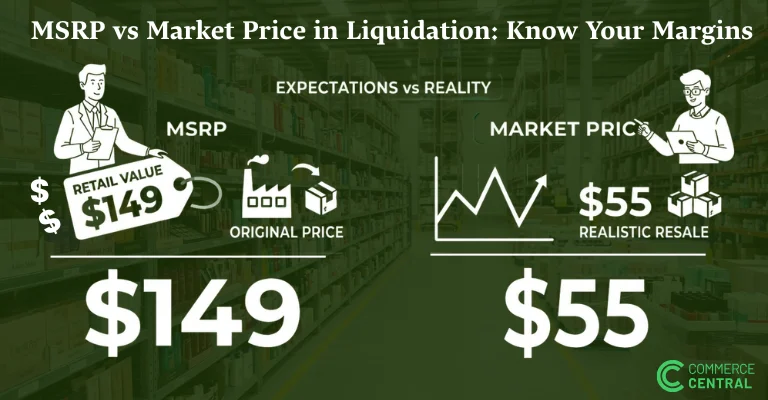
Generally, purchasers view liquidation as a method to obtain lower pricing on merchandise than what would normally be offered in other channels, such as retail.
However, liquidation is more about not purchasing troublesome product(s) than it is about finding better priced items.
There are few categories where this has proven truer than within the category beauty. When a buyer makes an error (i.e., prohibits sale of expired product), margin has not only eliminated but there often will be a loss due to the expense of returning the product. In addition to carrying risk from internationally-based suppliers, the beauty category has many unique operational issues, such as managing out-of-date products, hygiene standards, packing materials, and resale terms.
Most buyers are not careless; however, the marketplace (industry) offers incentives for buyers to purchase quickly without sufficient consideration of the above operational issues. The independent buyers do not work that way; they utilize a process that works for them.
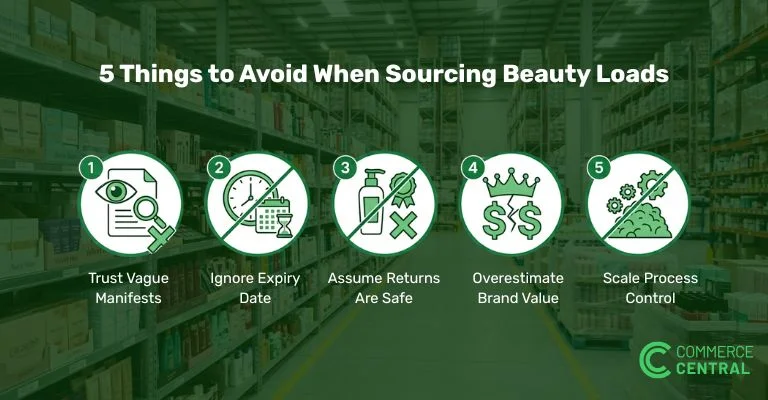
1. Smart Buyers Never Trust Vague Manifests
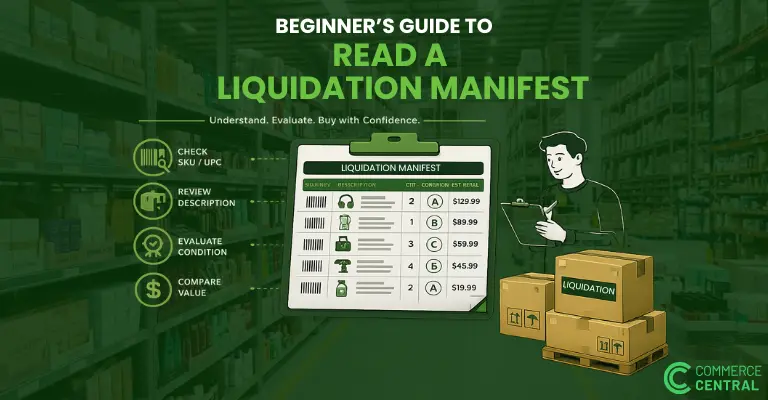
A vague manifest isn't just an inconvenience; it poses a structural risk.
When descriptions on listings include phrases such as "various beauty products," "various beauty items," or "health / beauty products," they eliminate key details buyers require in making a viable decision.
Specificity is critical in the beauty market for the following reasons:
- The brand(s) will dictate whether the product can be listed.
- The category of the product will dictate how the product must be stored.
- The way that the product is packaged will dictate whether it can be sold again.
- The different varieties (shade, formulation, quantity) will directly affect the product's demand.
These details are necessary for making a pricing strategy; therefore, if the buyer does not know the details before buying, they can only react to the products after they have bought them.
Many buyers are willing to buy because the price in a liquidated sale appears to be low enough to offset their uncertainty.
However, what makes a savvy buyer will be this: buying products with unclear inventories will require price adjustments after the fact, and these adjustments are more expensive than they would be if the details were known before purchasing.
Commerce Central eliminates that ambiguity by providing structured and usable data; therefore, when a buyer evaluates a load of products based upon available data, they do so with the intent of what they are buying instead of merely making assumptions.
2. Smart Buyers Never Ignore Expiry and Shelf-Life Dynamics
A product expiration date is not simply a date, but a timeline of how long you will continue to profit from that product. In beauty, the shelf life of a product governs:
- The ability to adjust your pricing
- The speed at which you can sell the product
- Your customer’s perception of your product
- Your compliance with the retailer’s platform
However, for many buyers, the expiration date is just another secondary detail. They believe they will move the inventory quickly enough to not have to worry about it.
This assumption is flawed under the current conditions:
- It can take time to optimize your listings
- Competition will also impact sell through rates
- There are storage requirements and delays that can eat into your selling window
As a result of all of these factors, your original 6-month runway can quickly shrink to just a liquidation process.
The best buyers do not evaluate the inventory based on its current condition; rather, they evaluate the inventory based on how much time they have left to sell the inventory.
Commerce Central helps with this by providing as much clarity around inventory expectations as possible, allowing buyers to align their purchasing decisions with more realistic resale timelines.
3. Smart Buyers Never Assume Returns Are Safe to Resell
Beauty product returns are fundamentally different from other types of products.
By nature, beauty product returns are higher risk. Although a beauty product may appear to have never undergone any damage, it may still present numerous risks to the buyer including:
- Compromised seals.
- Food contamination risks.
- Used condition.
- Damaged packaging.
Marketplace sellers, view these types of damages as violations of their policies. This is where many buyers approach the situation incorrectly; relying on the fact that an item appears to be "as new" allows them to be misled.
Smart buyers today know that resale requirements place a higher burden on sellers than simply looking at an item's condition.
Therefore, smart buyers use an expert like Commerce Central to verify and clarify expectations about an item's conditions prior to purchasing. Commerce centrals focuses on providing buyers with information upfront to avoid surprises in inventory delivered that do not meet marketplace requirements.
4. Smart Buyers Never Overestimate Brand Value
Brands create false expectations of reliability.
When viewing recognized brands in a LTL manifest, buyers think there is guaranteed demand for the brand.
The presence of a brand name doesn’t mean the products in that brand are sellable.
Savvy buyers will investigate the following:
- Whether or not a brand has restrictions or is gated
- Whether the buyer is authorized to sell the brand
- Whether the product type is still in demand
- Whether the packaging conforms to the listing's requirements
Even though a well-known brand could have poor packaging or limited demand, it could remain on the shelf longer than an unknown or a comparable new product could.
The liquidation industry usually emphasizes the name of the brands to create a perception of value. However, an experienced buyer knows how to differentiate between brand awareness and resale potential.
Commerce Central supports the distinction between brand awareness and resale by presenting inventory so that buyers can evaluate the ability of the items to be sold in the real world as opposed to what they are known for selling.
5. Smart Buyers Never Scale Beauty Loads Without Process Control
Increasing the beauty inventory without operational discipline can lead to a rapid increase in inventory paralysis, and at higher volumes each inefficiency becomes amplified.
Each of the following inefficiencies will compound as volume increases:
1.) Delayed sorting will increase the time from when product arrives to when it is listed.
2.) Bottlenecked inspection will limit your throughput of product.
3.) Mismanaged expiration tracking will result in lost product.
4.) Inconsistently graded product will result in increased returns.
What worked at lower volumes will break down as the volume expands.
Smart buyers will not scale their purchase volume before they scale their purchasing systems.
They provide defined inspection workflows, clear condition grading processes, efficient listing pipelines and inventory rotation strategies before they add volume.
Commerce Central provides the visibility that buyers require in order to create structured systems as opposed to just going after larger purchases.
The Bigger Issue: Beauty Liquidation Exposes Weak Strategy
Beauty did not cause poor sourcing habits to be present but rather revealed them. When acquiring beauty items, if a buyer does any of the following, they will be exposed for doing so:
-Relying on vague data
-Not considering operational restrictions
-Assuming resale without verifying it
Beauty products can bring to light any of the above shortcomings right away so that many buyers have difficulty with beauty. The reasons many buyers find it difficult to acquire beauty is not because of a lack of opportunity, but because there is no room for error.
At Commerce Central, we understand that high-risk categories demand higher standards of clarity and we design our company around this should be true.
What Actually Separates Smart Buyers
Discipline, Not Access
Smart Buyers:
- Value Information Over Discounts
- Value Risk Over Margin
- Value Systems Over Scaling
- View Sourcing as a Process, Not as an Event
In other words, the value of avoiding bad inventory is always going to exceed the value of trying to score a “good deal.”
Commerce Central’s Valuation Method achieves this same goal by reducing the embarrassment of not having the necessary level of inventory to support disciplined decision making.
Conclusion
The Beauty Liquidation process provides zero room for error.
For buyers, outcome is based on correct assumptions and precise measurements.
The vast majority of buyer loss is caused by ignoring indicators or warning signals which include:
- Vague (not clear) manifests
- Product that is nearing expiry or has unclear dates
- Questionable product condition
- Brands that are overvalued
- Scaling too quickly before having a history to support those products
Intelligent buyers (in the liquidation business) do not make better guesses than others – they simply have more rules they can depend on and chose liquidation channel smartly.
In addition, few, if any, buyers can expect the liquidation process to provide them any sense of security regarding rules enforcement.
Commerce Central was designed to remove all five of these concerns.
FAQ
Why is beauty liquidation more complex than other categories?
Because it involves expiry dates, hygiene standards, and stricter resale compliance requirements.
What should buyers verify before sourcing beauty loads?
Brand eligibility, shelf-life, packaging condition, and resale platform requirements.
Are beauty returns safe to resell?
Not always. Many are opened or used, making them unsuitable for resale.
How can buyers reduce risk in beauty liquidation?
By focusing on transparency, avoiding vague manifests, and aligning purchases with operational capacity.
Is liquidation sale a reliable sourcing method for beauty products?
It can be, but only when buyers apply strict evaluation criteria and prioritize clarity.