
Clearing Space Without Compromise
Improve liquidation predictability with structured data, clear processes, and strong guardrails. Commerce Central delivers faster cycles and higher recovery.
November 14, 2025Read Article

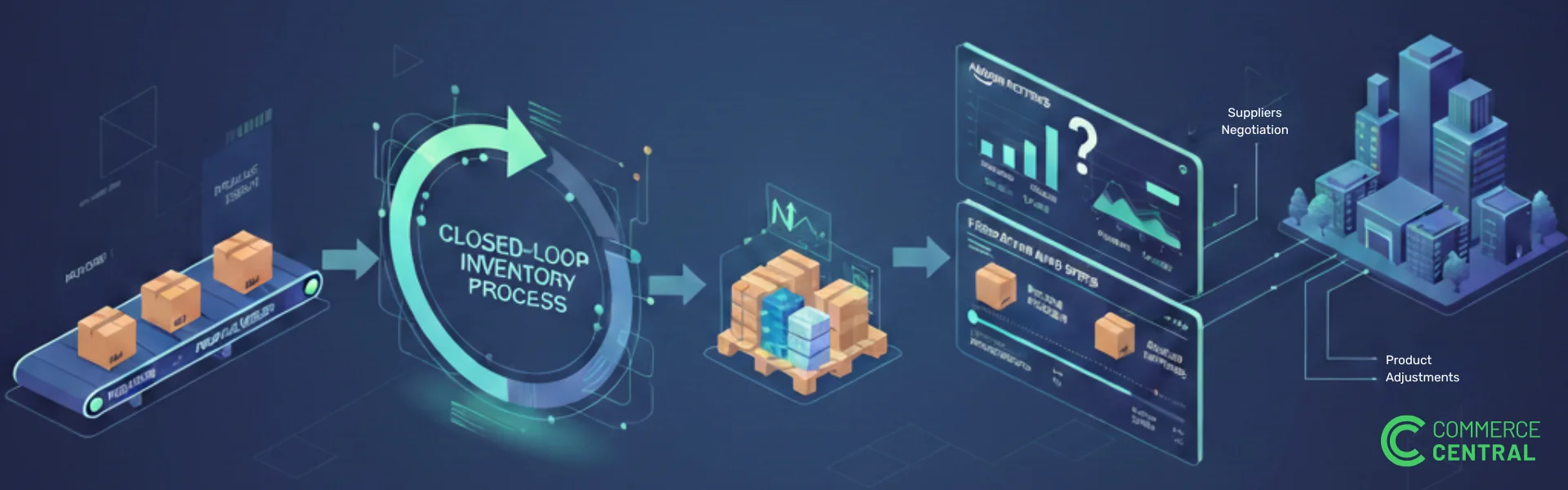
A closed-loop inventory process is not just for large corporations. It is an organized system where information about inventory moves both ways: downstream into liquidation channels and back upstream into future planning.
Instead of treating liquidation as the final stop where a unit was simply sold off, sellers can use liquidation data to make better decisions around:
If recovery rates are strong in secondary markets, that may show demand still exists but the original price positioning was wrong. If recovery rates are weak, it may point to a deeper demand problem that should reduce future purchasing commitments.
This same shift toward data-driven disposition, visible in Walmart’s recommerce work under Avi Prakash, also shaped Commerce Central’s view that liquidation data should feed upstream planning instead of dying at the point of sale.
Closed-loop inventory turns liquidation into measurable intelligence instead of silent loss.
Amazon dashboards provide useful surface-level metrics like sell-through rates, return rates, conversion rates, and inventory age. These are important, but they do not always show why excess inventory is building up.
When sellers examine how products perform after they enter liquidation channels, new patterns become visible.
Some products that perform poorly at full retail may sell through quickly in secondary markets. That usually means the issue was price positioning, not demand. Other products may perform poorly in both retail and liquidation channels. That points to a more fundamental product-market mismatch.
Timing also matters.
If inventory enters liquidation shortly after a replenishment cycle, the forecasting model may have overestimated sustained velocity. If seasonal inventory fails to sell before demand shifts, the seller may need to recalibrate the seasonal curve for that SKU.
By reviewing liquidation performance at the SKU level, sellers can uncover blind spots that forward-facing sales data often hides.
Returns are often treated as friction in ecommerce. But they are also one of the clearest sources of operational feedback.
If certain SKUs keep showing up in liquidation channels because of high return rates, that is not random customer behavior. It usually means something needs to be reviewed.
For example, if a SKU has a high return rate and many customers cite “not as described” or “poor quality,” the seller may need to adjust the product, improve the listing, change images, update packaging, or renegotiate with the supplier.
Liquidation recovery then shows the financial impact of the issue.
If returned units recover very little value in secondary markets, the cost of the upstream mistake becomes much clearer.
That is why closed-loop inventory matters. Supplier discussions should include return rates, damage patterns, and recovery outcomes. Packaging improvements should be based on actual damage history. Listing changes should be based on the gap between customer expectations and reality.
Without that connection back upstream, liquidation only absorbs the cost of earlier mistakes. It does not help prevent them.
Capital tied up in slow inventory is frozen capital.
It could be used for faster-moving SKUs, advertising, product development, supplier diversification, or better buying opportunities. But when sellers delay liquidation decisions because of hesitation or over-optimism, that capital stays stuck while storage fees, holding costs, and opportunity costs continue to grow.
Structured liquidation thresholds make these decisions more objective.
A seller can set triggers such as:
Once those triggers are defined, inventory can move into the right liquidation or recommerce channel based on data instead of panic.
The goal is not just to sell excess inventory. The goal is to extract useful data from the liquidation process and use it to improve capital allocation going forward.
That creates better liquidity, more stable margins, and greater capacity to reinvest.
As competition increases and storage costs rise, repeated forecasting errors become more expensive.
Sellers who stay reactive are always trying to fix excess after the damage is done. Sellers who build closed-loop inventory systems shorten the learning cycle.
Each liquidation event becomes a source of feedback.
The sellers who take this approach no longer view liquidation as a failure. They use it as structured market feedback.
The compounding advantages include:
The goal is not to eliminate liquidation entirely. That is unrealistic.
The goal is to make liquidation intelligible.
Liquidation will always exist in ecommerce. Forecasts will never be perfect. Demand will shift. Returns will happen. Some products will miss the mark.
The real question is not whether a seller will eventually liquidate inventory. The real question is whether the seller learns from it.
When liquidation data is connected to a closed-loop inventory system, excess inventory becomes more than a loss recovery exercise. It becomes a source of intelligence that can improve forecasting, supplier negotiations, pricing, packaging, and future purchase planning.
Sellers who choose liquidation channels based only on speed may move inventory faster in the short term. But sellers who prioritize transparency, SKU-level reporting, and recovery data are better positioned to build stronger inventory plans over time.
Liquidation should not be the end of inventory intelligence.
It should be one of the first signals used to improve upstream control.
In a market where operational efficiency matters more every year, the sellers who build feedback loops into their inventory process will outperform those who simply move goods out and move on.
What is closed-loop inventory?
Closed-loop inventory is a system where downstream sales, returns, and liquidation data inform future purchasing, forecasting, pricing, and supplier decisions.
How can liquidation improve forecast accuracy?
Liquidation data can reveal recurring overstock patterns, demand miscalculations, pricing sensitivity, and SKUs that perform better in secondary markets than at full retail.
Should sellers treat liquidation as part of planning?
Yes. Strategic sellers define liquidation pathways before inventory becomes excess, so decisions are based on thresholds and data instead of last-minute pressure.
Is listing liquidation pallets for sale harmful to brand value?
Not when managed through the right marketplace environment with transparency, buyer controls, and a clear resale strategy.
Why is liquidation data valuable?
Because it reveals demand elasticity, SKU resilience, return patterns, supplier issues, and forecasting gaps that standard sales dashboards may not fully expose.
Improve liquidation predictability with structured data, clear processes, and strong guardrails. Commerce Central delivers faster cycles and higher recovery.

Avoid audit headaches and compliance risks by properly documenting and tracking inventory offloads, keeping finance and legal teams confident.

Don’t let outdated returns processes slow you down. Discover how reCommerce can digitize the last link of your supply chain and drive efficiency.
See what's available now full manifests, real prices, ready to ship. No account required to view.