“I won the liquidation auction. I lost my Amazon listing.”
That’s the sentence no seller is ready to say until they are.
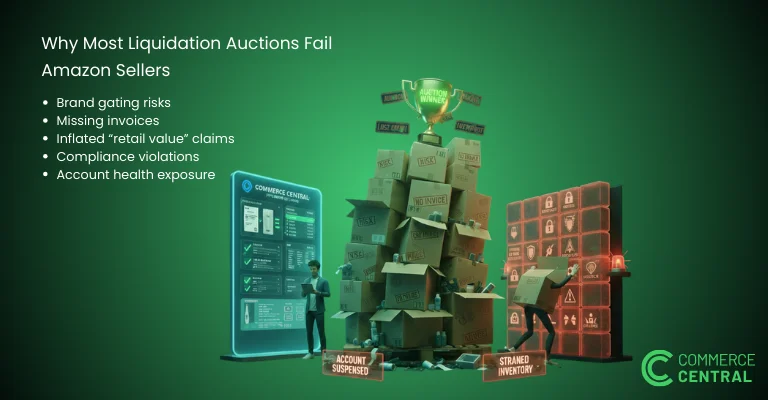
Every year, thousands of Amazon sellers gravitate towards liquidation auctions online thinking they’ve hit the jackpot: discounted inventory, brand-name products, fast margin expansion. But what a lot of people find out is that the easiest part is winning the bid. The true danger starts after the product delivery.
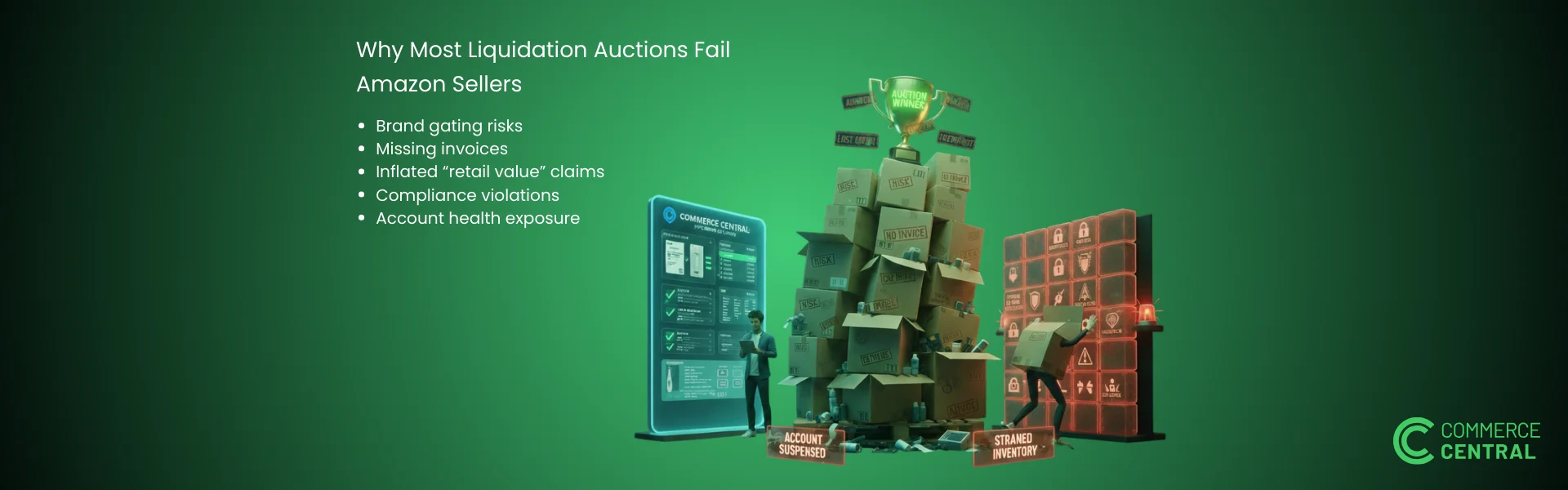
Compliance issues. Gated brands. Missing invoices. Shelf-life problems. Condition disputes. Ghosted communication.
The vast majority of liquidation auctions do not fail because the price was incorrect. They are failing because the structure was.
Commerce Central was founded because we wanted to solve this specific problem: replacing speculation with informed sourcing.
The Illusion of Margin in Liquidation Auctions
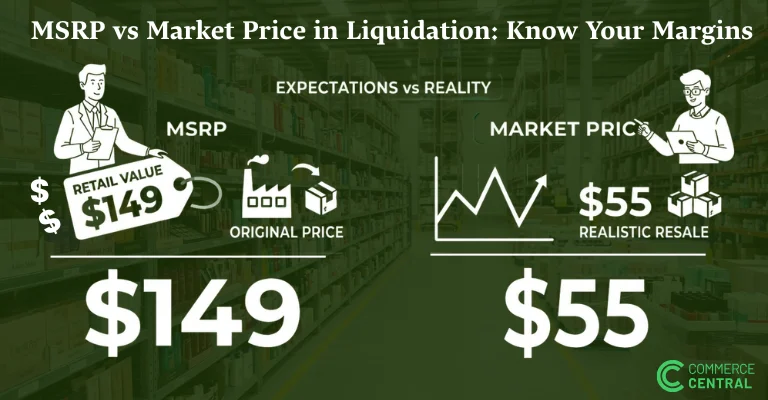
Liquidation auctions create a sense of urgency through countdown timers, competitive bidding, and “retail price” comparisons. The atmosphere is designed to encourage quick actions rather than thoughtful consideration.
On the other hand, Amazon isn’t a garage sale type of marketplace. It’s a compliance and documentation driven marketplace. The inventory must be in a condition to be sold and the brand must qualify. The invoice must meet the requirements for verification.
Therefore, when sellers chase high margin pallets without giving thought to their resale potential, they are confusing discounting with opportunity.
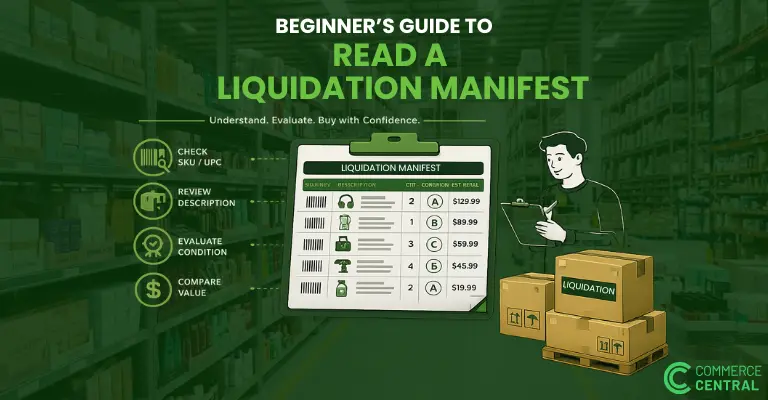
Commerce Central is changing this mentality. Rather than asking the buyers to trust imprecise and vague manifests, it provides clarity as to what is included in the pallet, what the pallet condition will be, and what that will realistically look like in terms of a resale channel.
In order for there to be a margin, the product must be listed in the seller’s inventory.
The Compliance Wall Most Sellers Hit
The most surprising aspect for newcomers to buying liquidation is brand gating processes.
A seller purchases a liquidation auction with an established brand, receives a pallet of authentic goods but runs into problems like:
- Being restricted from listing the brand
- Having to get approvals in order to sell in a specific category
- Receiving requests for distributor invoices or proof of authenticity, and
- Being required to provide proof of product authenticity via audit of their documents
If there are no documents or other proof for the fruited inventory, then that inventory is 'stranded' and could represent a significant loss to the seller.
In most cases when auctioning on pallets, most sellers lose out on the product not having a viable resale channel; therefore, their profit is lost before they ever buy the pallet of goods.
Commerce Central understands this and works backwards by providing branded and fully transparent information before a seller purchases goods so that they can review the resale of each individual item against the buyer's resale guidelines prior to buying the pallet.
The Manifest Mismatch Problem
There is another type of horror story that often occurs relating to discrepancies related to the products that are received from liquidation auctions. Sellers often have certain expectations of the products that they are going to receive (specific product brands, expected quantity, resalable condition), but they often receive products that do not meet their expectations (canned goods with lids damaged, products that are about to expire, generic substitutes for the actual products ordered, and shipping boxes that have no containing items to match up with the count of what they ordered).
In liquidation auctions there is little to no recourse available. Sellers will often find that once they buy the items, there will be minimal to no support and vague explanations if they ask for additional support. Commerce Central has identified the damage to the seller’s trust occurs here through expectation gaps and not price differences. Improved inventory presentation and realistic disclosures will allow sellers to intentionally source products and not buy reactively to the buyer’s price at auction.
Why Pallet Auctions Reward the Wrong Behavior
Pallet auctions induce behavioral distortion and outcome based on:
- Reinforcing aggressive bidding,
- Emotional momentum, and/or
- Competitive urgency.
Pallet Auctions will not reward:
- Conducting compliance analysis,
- Conducting checks for brand eligibility, or
- Conducting listing feasibility review
Amazon Sellers who have a sustainable and scalable business will increasingly approach sourcing strategically by asking themselves if they will be able to list and sell those items pursuant to policy verses being able to win the bidding for that pallet. Commerce Central supports the latter question, but not the former.
Documentation and the Ghosting Dilemma
One of the most hurtful repeating trends in failed liquidation auction experiences is the lack of post-sale communication by the seller.
Sellers share that they have:
- Submitted invoice request and have not received responses.
- Submitted clarification requests for product manifest and have not received answers.
- Asserted refund requests and have received no feedback.
- Complained about condition and received no assistance.
Without the appropriate documentation or responsive assistance, the seller ends up absorbing their own loss.
Commerce Central believes that it is best if there is clarity pre-purchase, once the funds have been spent, the seller's leverage is at an all-time low. A transparent listing decreases the need for damage control after the sale occurs.
"The best dispute is one that never occurs"
How Sellers Purchase Pallet Inventory Without Compliance Criteria
Many sellers often make error while searching for pallet purchases online or in physical stores, believing that any discounted product can be sold through the Amazon platform.
While this may be true for many sellers who sell through eBay, the Amazon platform is algorithm and policy-driven.
The criteria that Amazon utilizes to rate a seller will include:
- Authenticity Indicators
- Customer Feedback
- Return Rates
- Health of Account Metrics
Purchasing product without considering whether or not the items comply with Amazon’s policies is detrimental to more than just a potential lessening of profit for the seller. Purchasing items without evaluating any potential compliance risk will not only impact the seller's profit margin but can also lead to a loss of selling privileges on the Amazon platform.
Commerce Central reiterates the need for congruence between our sellers’ sourcing and resale channels within Amazon’s policy structures when purchasing liquidation products. Purchasing liquidation inventory should be a well-mapped process and not just happenstance for our sellers.
Understanding Shelf-Life and Condition
In typical consumption categories like groceries, health & beauty, having shelf-life visibility is incredibly important.
Many liquidation auctions publish products for sale and fail to specify any meaningful shelf-life expiration time period. Therefore, when merchants receive their inventory, they find that there's very little time remaining before their products cannot be resold.
This results in the following:
- Accelerated markdowns
- Storage losses
- Disposal costs
Commerce Central mitigates this risk by focusing on upfront shelf-life awareness, where shelf-life applies, and having transparent timing to protect sellers from inventory degradation that impacts margins in an unnoticeable way.
The Amazon Account Risk that No One Talks About
While the most significant financial impact associated with unsuccessful pallet auctions is the loss of capital, perhaps the more troubling impact is the impact on account health.
The re-instating/re-publishing of items on Amazon due to listing removals/genuine product complaints/negative customer experiences/product safety flags come with penalties from Amazon's system. Amazon does not care if an account holder did not know; they care only about the tracked performance metrics of the Amazon seller.
Amazon has an algorithm that observes when a seller engages in reckless sourcing.
Commerce Central is designed to support the sellers who understand that maintaining a healthy account is worth much more than winning a short-term auction.
Valuable Alternatives to High-Risk Auctions in Liquidation
Liquidation isn't the enemy; it's poorly designed auction environments that pose a risk to sellers.
A strategic sourcing model emphasizes:
- Real product visibility
- Honest condition ranges
- Clarity of shelf life
- Transparency in brands
- A realistic alignment for resale values
Commerce Central focuses on all types of liquidation as a supply channel rather than as a speculative transaction. Sellers who purchase pallets through a structured and disclosure-based environment minimize surprises and create a more predictable outcome for themselves. Predictability is a scalable thing; gambling isn't.
Reality Check
Most Auction Liquidation experiences fail to deliver success to Amazon Sellers because they have been optimized for speed and/or price versus compliance and/or sustainability. Winning a bid is thought of as being a growth opportunity, while passing on a risky pallet feels like going nowhere. Experienced sellers know something that newer sellers do not; the best auction liquidations often happen when you do not win the bid.
Commerce Central has created a platform to help make that more clear to potential buyers.
Final Thoughts
If your model of sourcing is based on either optimism, a sense of urgency or artificially inflated retail prices, it will ultimately fail. If your source model is based upon transparency, legal resale alignment and understanding of compliance, it will scale successfully. Liquidation by itself is not dangerous.
Opaque liquidation auction systems are.
The difference between growth and regret is clarity.
FAQ
Why do most liquidation auctions fail Amazon sellers?
Because they often lack brand visibility, documentation clarity, and compliance alignment needed for Amazon resale.
Are pallet auctions safe for Amazon FBA sellers?
They can be high-risk if sellers do not verify brand gating, condition standards, and resale documentation beforehand.
What is the biggest hidden risk in a liquidation auction?
Buying inventory that cannot legally or practically be listed due to Amazon compliance restrictions.
How can sellers reduce liquidation sourcing risk?
By choosing sourcing environments that prioritize transparency over urgency.
Is it safe to buy pallets for Amazon resale?
Yes — but only when the inventory aligns with Amazon policy and resale eligibility requirements.