Liquidation buyers generally do not experience financial failure due to poor quality inventory but rather due to misunderstanding the terms of the purchase agreement.
The manifest represents more than a legal formalism but also gives the buyer an organized assessment of the items purchased prior to a significant cash investment. Without understanding how to analyze a manifest correctly, you’re not making an informed business decision; instead, you’re merely reacting to misleading figures aimed at affecting the buyer’s perception of value.
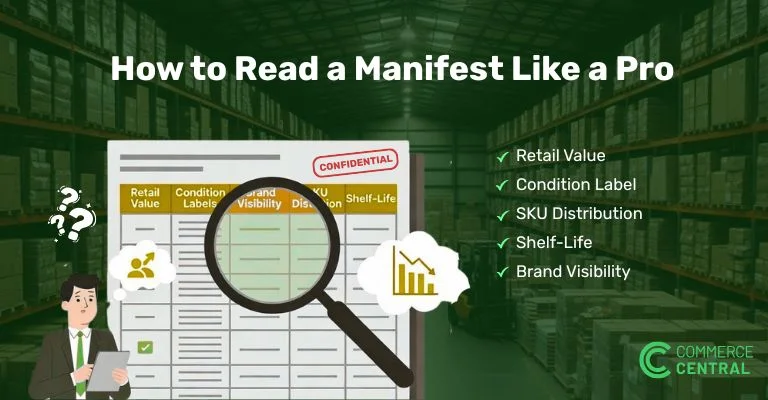
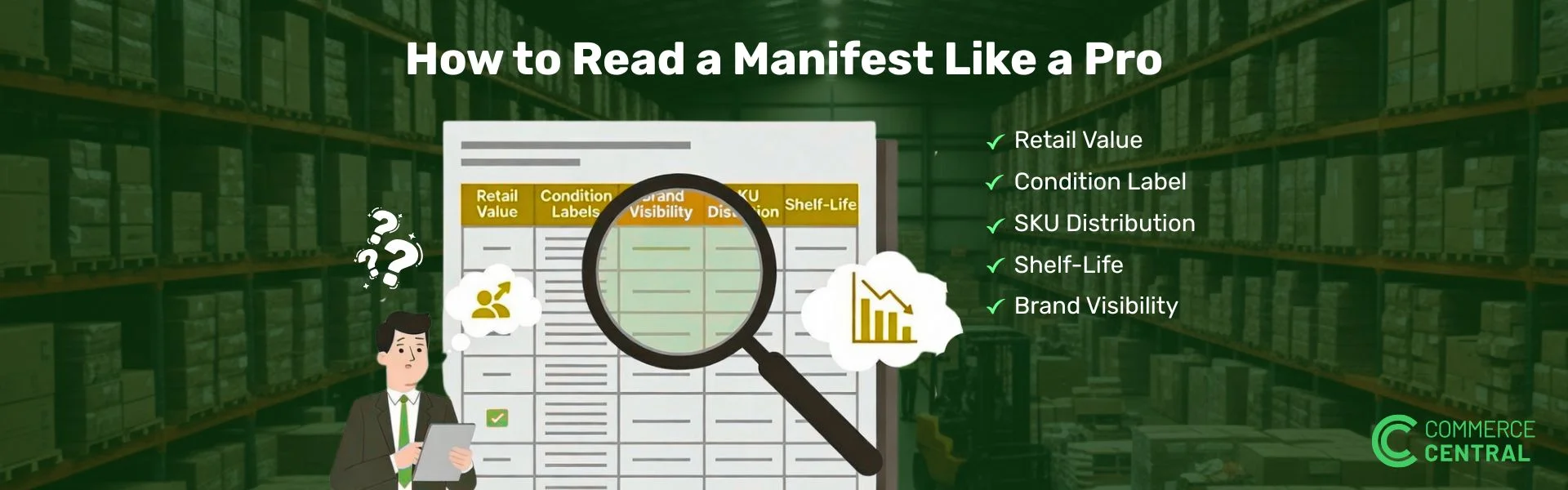
A thorough understanding of how to read a manifest will assist you in determining if your purchased return pallets will be profitable or not. To facilitate this process, here are just some of the items you will find professionals reviewing prior to placing an order for merchandise return pallets.
The Industry Myth: “The Manifest Is Transparent by Default”
It isn’t.
The process of making a purchase is just being able to take a snapshot of what you will receive, while not necessarily understanding how to use it. You will be presented with numbers, without any reference points for those numbers. There will also be total amounts listed for each item, but no basis for understanding the impact of those numbers on operations.
New buyers will review manifests in a passive manner and are just looking for validation through high retail totals, recognizable categories, and large quantities.
Experienced buyers will review manifests in a way that they think about the possibility that there are going to be problems, and will purposely look for those problems.
Some questions they will be asking include:
- What is not being represented on this document?
- What does this encouragement lead to in terms of creating assumptions?
- In what areas do you expect that margin will decrease as a result of this data?
Commerce Central realizes that the way an item is presented affects how confident one is about making a purchase. That is why the way items are sourced requires an examination in addition to just the total amounts listed.
Retail Value: The Most Misused Number in Liquidation
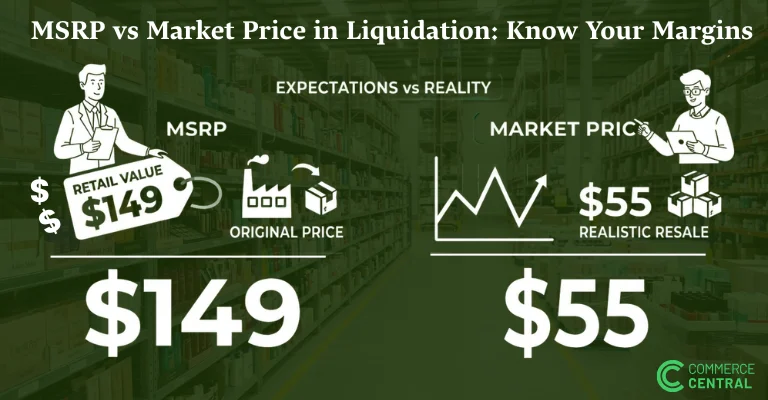
Retail value will vary from resale value; however, it is typically used as the foundation for establishing pricing on product listings. The reason for this is that retail totals are considered very large and therefore lend themselves to an emotional mentality, such as “Even if I only get 50% of this total at resale, I will still win.” Professionals will immediately reject this line of thought, as they know: Retail prices may have been set many months/years ago; Online marketplaces compress retail pricing very quickly; Clearance cycles decrease the value of products very quickly; & Consumer demand changes seasonally.
Rather than rely on MSRP for making purchase decisions, experienced buyers look at what is currently happening in the secondary market. They analyze what actual selling prices are, and how quickly item restocks happen based on what has previously sold.
Commerce Central does not utilize high-value anchor points based on MSRP; instead, we focus on providing our members with the information they need to make sound purchasing decisions. The most accurate way to make a valid purchase decision is to have realistic valuation; where the purchase only makes sense if you accept retail pricing at face value, it most likely will not work.
Condition Labels: Where Margin Quietly Disappears
In terms of liquidation, condition is the most important profit variable and one that is poorly described. For example, “customer returns” can mean:
- A box never opened
- A box with mild visual damage
- A box with missing parts
- A box that does not work at all.
“Mixed Condition” can hide a wide range of quality differences among the SKUs. Professionals do not accept blanket descriptions; they evaluate the item in operational terms.
- What percentage of the items may be unsalable?
- What percentage of the items will require repair?
- How many labor hours will be needed to inspect the items?
- What return rate can this particular category expect?
Commerce Central believes that by providing clearly structured methods to represent item conditions, we can remove the unpredictability created by providing vague condition definitions across a large number of items. Without defined conditions, buyers cannot accurately predict resale amounts for their purchases, and that is where over-payment starts.
Brand Visibility Determines Resale Power
A list of assorted premium brands’ products without brand names creates a gap in the strategy. Brands have a direct impact on the following:
- Gating Expectations and Eligibility of Amazon
- Price Impacts
- How many times something is returned
- Assessment of authenticity
- Intellectual property legal risk
When buying wholesale pallets of merchandise that will eventually be sold to consumers, the professional buyer does not assume the items they are purchasing will be gated, they verify that they will not be gated, and know that gated merchandise is not only annoying but an investment in capital that can’t be used until after it has been sold.
In the absence of brand transparency a buyer cannot make an informed decision about making a purchase.
Every purchase is based upon the buyer’s assessment of its resale viability, and brand clarity is not only cosmetic but structural in nature, and assists the buyer with evaluating a purchase before dollars are expended.
When there is no brand clarity there is no clarity in the buyer’s risk profile.
SKU Distribution: The Silent Concentration Risk
Larger manifests do appear to be more diverse at first glance since they contain 1,000 different units. However, experts will check to see:
- How many different offers (SKUs) are included?
- What percentage of the total number of units is represented by the top three offers (SKUs)?
- Are there any low-value filler items that are skewing the total unit count?
One area of risk that is often overlooked in liquidation is concentration risk. If 40% of your potential revenue is dependent upon one offer (SKU), and that offer (SKU) does not meet expectations, the entire margin model will be impacted.
Commerce Central’s clarity-first positioning will assist retail liquidators in making better decisions regarding distribution by requesting information in an organized and structured manner, compared to merely collecting surface-level totals.
In liquidation you are protected by balance. You are at risk of concentration.
Shelf-Life: The Invisible Clock
Time is the inventory of consumables, health, grocery and beauty.
When a manifest lacks a clear expiration date it transfers complete risk onto the buyer. A buyer’s risk is based on
- Analyzing remaining sell-through window.
- Time necessary to prepare for sale.
- Time required for listing approval.
- Potential discounting acceleration.
For example, a product that has 120 days remaining until expiry, requires 30 days for preparation and approval to sell means the window to sell the product has narrowed considerably.
Commerce Central understands that providing the buyer with the clear cover for margin compression due to timing lack of visibility prevents invisible inventory decay from being an unreported leak in profit.
Shelf-life of a consumable is not a detail, but rather an indicator of time.
Freight and Operational Impact Start on the Manifest
A manifest contains much more than just the description of your inventory; it also provides a prediction of your operational workload.
Experienced buyers analyse
- Volume and warehouse square footage available to stock.
- Specific to each product category, preparation time needed to prepare product for sale.
- Product testing required prior to resale for electronics.
- Sorts/locations/shipping/packaging of apparel.
Current commodity charge rates for transportation-related costs will magnify the operational variable of the load. What appears profitable on paper may not continue to be profitable once the load is unloaded and the handling commencement occurs.
Commerce Central’s philosophy is to have clear visibility to timing based on truthful records. Participants in this business can make proactive decisions and not casualty victims of operational incidents after delivery but prior to.
Pallet price is the first step. Pallet operational cost is second step.
The Behavioral Mistake Most Buyers Make
Amateur and professional people are differentiated by their mindsets rather than by their level of intelligence.
Amateurs use manifests to look for ways to achieve success in the manifest.
Professionals use the manifest to find out what they would use to disqualify the deal.
- What can happen with this deal that the manifest does not say?
- What have I underestimated?
- Which of the variables to this deal are not always predictable?
Only after the deal has passed through significant scrutiny will the professionals continue to work with the buyer to complete the transaction.
Commerce Central supports this disciplined way of thinking by promoting a clear process to support both rejections and acceptances.
Professional buyers reject more transactions than they complete.
What “Professional” Really Means in Manifest Reading
Professionalism does not come from the presence of spreadsheets or extensive models, but rather from being able to present with certainty the following four things:
- How many major SKUs have been sold through the resale channel;
- What are the degree of potential compliance risks involved;
- What is the burden of alternate source operations;
- What is the worst-case margin.
If you cannot report on these areas, you’re really relying on hopes and dreams - that is not a sourcing strategy.
Final Takeaway
A manifest is not paperwork.
The “Manifest” is a form of physical document that contains the most substantial risk associated with your liquidation transactions.
Many buyers lose money in liquidation as a result of non-compliance issues.
Instead, buyers lose money in liquidation as a result of:
- Trusting Potentially Inflated Retail Totals
- Accepting Vague Condition Descriptions
- Not Verifying Brands
- Ignoring Concentration Risks
- Underestimating Operational Costs
Those with professional experience know that there is likely friction and will include that when pricing items purchased.
Because with respect to liquidation, the biggest error a Buyer can make is not buying an entire pallet.
It is also to misinterpret the “Manifest” from a transaction that would give a buyer advanced warning regarding an item previously not being in compliance to the liquidation process.
FAQ
What is a liquidation manifest?
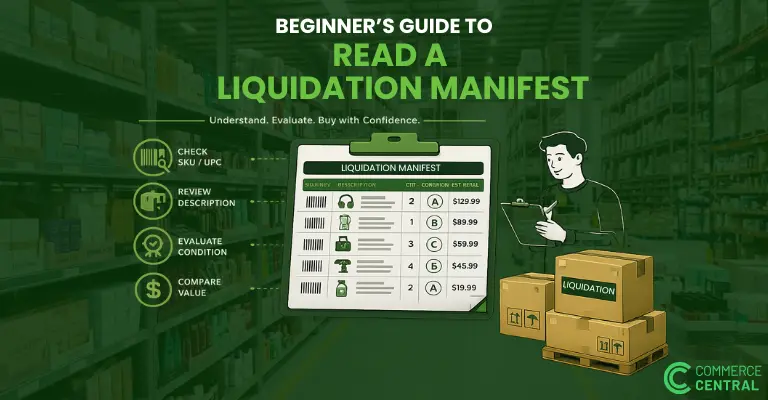
A liquidation manifest is a document listing items included in a pallet or load, including quantities, estimated retail values, and sometimes condition details.
Why do buyers overpay for pallets?
Because they rely on MSRP totals and vague condition labels instead of analyzing resale viability and risk exposure.
What should professionals check first in a manifest?
Brand visibility, SKU distribution, condition clarity, and resale eligibility.
Can a manifest hide risk?
Yes. Inflated retail totals and broad condition categories can distort actual resale value.
How can buyers avoid surprises?
By analyzing manifests critically and sourcing from platforms that prioritize structured transparency.